
Bubble Factor describes the relationship between the value of lost chips and won chips: in an ICM model, losing a certain number of chips usually reduces your tournament equity more than winning the same number increases it. That is why many calls that are profitable in chip EV become losing calls in $EV.
What is Bubble Factor?
In a chip EV model, winning and losing 10bb have equal and opposite values. In tournaments, the payout structure and risk of elimination mean losing chips can hurt more than winning the same number helps.
Bubble Factor measures that asymmetry. The higher it is, the more careful you must be with calls, especially when your tournament life is at risk or a large share of prize-pool equity.
Why calls suffer more
The player shoving can win the pot without showdown. The player calling an all-in must go to showdown. That is why ICM often separates shoving ranges and calling ranges more than raw equity suggests.
- High Bubble Factor means you need more equity to call.
- A medium stack facing a player who covers them often needs more equity than pot odds alone suggest.
- When another player is short-stacked, being eliminated before them can be especially costly.
- The same hand can be a good shove but a bad call.
Bubble Factor and Risk Premium
Risk premium is the extra equity needed to call because of tournament risk. Bubble Factor measures the imbalance between winning and losing chips; risk premium expresses its effect on the equity required to call.
If a hand needs 38% equity in chip EV, it may need 45%, 50% or more under ICM. The higher the Bubble Factor, the higher this hidden tax on calling becomes.
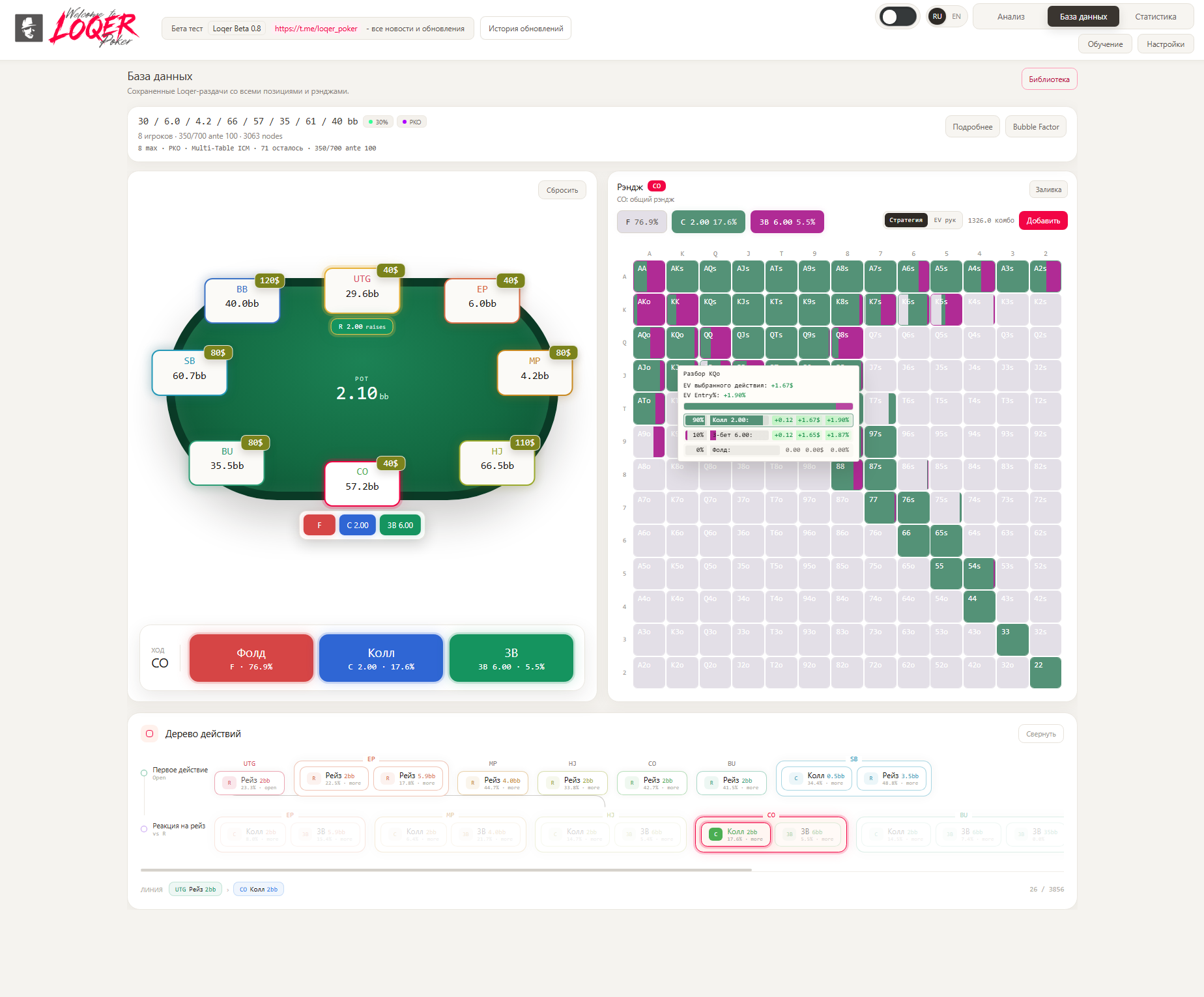
In the LOQER replayer you can open a specific hand, inspect the EV of each action and see where ICM pressure turns a close call into a fold.
How to study Bubble Factor in LOQER
theory -> actionChoose a spot
Look for a final table, bubble, the final-table bubble or a hand where a big stack pressures a medium stack while a short stack is present.
Review hand EV, not only frequency
Open the matrix and the hand review card that appears on hover. Compare call, raise and fold EV to see which hands fall out because of tournament risk.
Turn the spot into a rule
For example: a medium stack versus a covering stack calls tighter than chip EV suggests when a short stack is at the table.
When Bubble Factor is high
Bubble Factor is high when elimination or a large loss would sharply reduce your expected payout.
- Tournament bubble.
- Before a major pay jump.
- Final table against a player who covers you.
- Satellites where the remaining prizes are identical tournament entries.
- Spots where a very short stack is still at the table.
Is Bubble Factor always above 1?
In regular ICM spots, usually yes: losing chips hurts more than an equal win helps. But in PKO tournaments, the effective Bubble Factor can be below 1 when you cover the opponent and can win their bounty. The knockout adds direct money EV to winning, so the value of victory can outweigh standard ICM pressure. That is why some PKO calls become profitable even though they would be folds in a regular tournament without bounties.
Is Bubble Factor only about calls?
It is most visible in calls, but it explains the whole pressure dynamic: who can attack wider and who must defend tighter.
How are ICM and Bubble Factor connected?
ICM estimates the payout value of stacks. Bubble Factor shows the asymmetry between winning and losing chips in one decision.