
Risk premium is the extra equity you need to call beyond the threshold given by pot odds, because of ICM. The more a loss would reduce your expected payout, the higher this premium and the tighter your calling range.
What is Risk Premium?
In cash games or a simple chip EV model, a decision often comes down to pot odds: how much you must call and how much equity you have against the opponent's range. In tournaments, that is not enough because losing the pot can cost tournament life, a pay jump or a valuable stack position.
Risk premium is the extra equity needed above the chip EV threshold for a call to be profitable in payout terms. If pot odds require 35%, ICM may require 42%, 48% or more.
Why the premium appears
Under ICM, chips do not have a constant cash value. Losing chips often reduces your expected payout more than winning the same amount increases it. A call therefore needs enough equity to account for both the pot odds and the additional tournament risk.
- Calling an all-in means going to showdown and risking elimination if the opponent covers you.
- The player who shoves can win the pot without showdown and shove a wider range.
- A medium stack is especially vulnerable against a covering stack.
- The presence of a short stack at the table makes the medium stack's bustout even more expensive.
Connection to Bubble Factor
Bubble Factor shows how much more painful losing chips is than winning chips helps. Risk Premium turns that pressure into a practical question: how much extra equity does the hand need to call?
When Bubble Factor is high, risk premium also rises. A hand that looks like a clear call in a chip EV model can become a fold under ICM because it lacks the extra cushion against bustout cost.
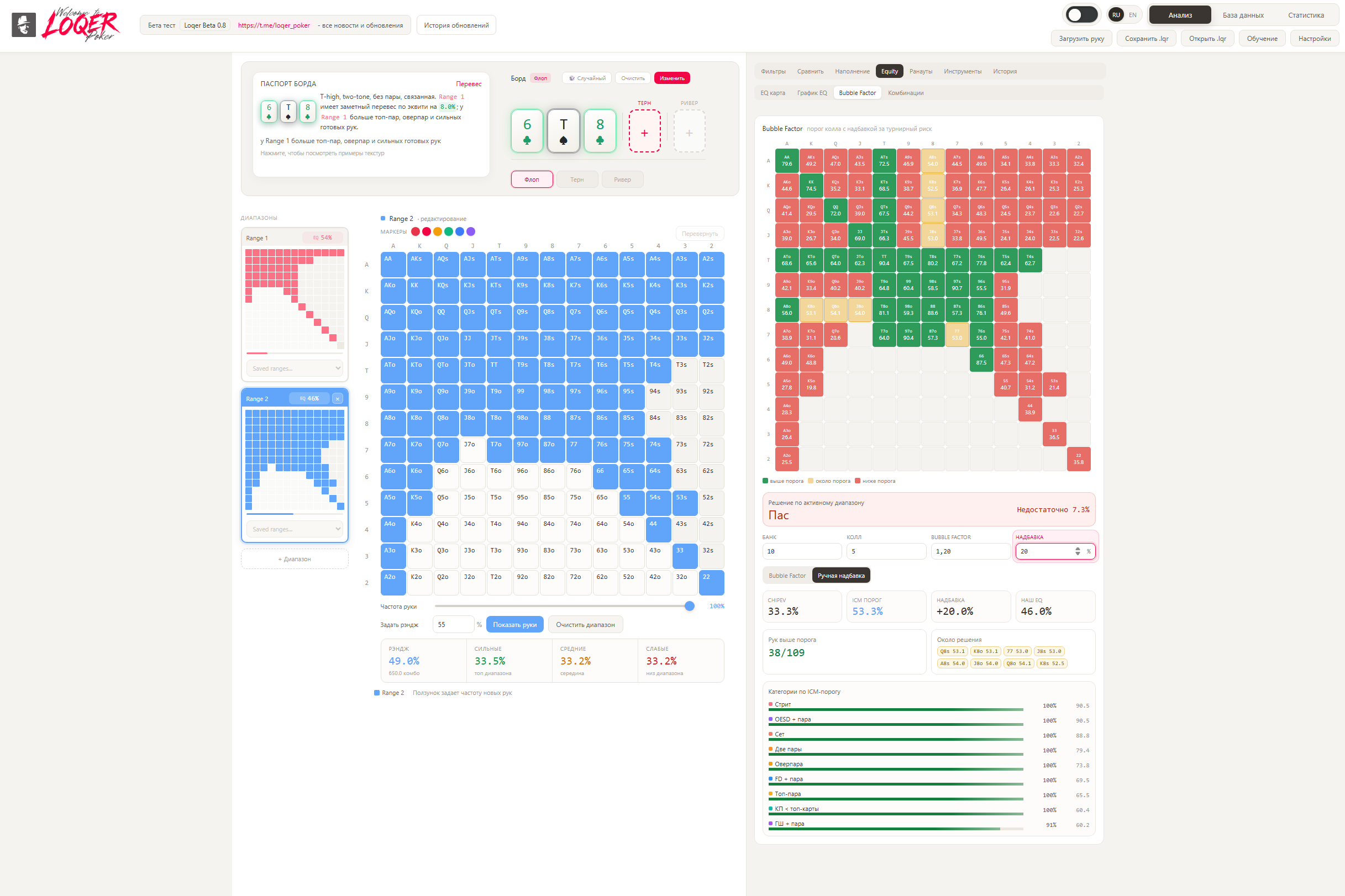
Open the hand in the replayer, hover a specific combo in the matrix and compare action EV. You can see where raw equity is enough and where risk premium turns a call into a fold.
A simple example
Imagine a final table. The big stack shoves, you have a medium stack, and a short stack is still at the table. In chip EV, your hand may look strong enough to call against the shoving range.
But if you lose, you bust before the short stack and lose a significant amount of tournament equity. If you win, the gain in tournament equity may be smaller than the loss you risked. That is why Risk Premium is added to the normal equity threshold.
How to study risk premium in LOQER
from theory to reviewFind an ICM spot
Final tables, bubbles, final-table bubbles and spots where a big stack pressures a medium stack work best.
Compare action EV
Look beyond the cell color in the range. Compare the EV of calling, folding and any other available actions. Borderline hands are the first to suffer from risk premium.
Save the rule
For example: against a covering stack, a medium stack cannot call by normal pot odds when a short stack and a major pay jump are present.
When Risk Premium matters most
- On the tournament bubble or before a major pay jump.
- At final tables where stack sizes differ sharply.
- When an aggressive big stack covers you.
- In satellites, where survival can be more important than chip accumulation.
- In PKO tournaments, where bounty value can partially or fully change the calculation.
Are Risk Premium and Bubble Factor the same?
No. Bubble Factor describes the asymmetry between winning and losing chips. Risk Premium describes how much extra equity a call needs because of that asymmetry.
Is Risk Premium only about calling?
It is most often discussed in calls, because the caller accepts showdown risk. But the idea explains the whole ICM pressure dynamic: who can attack wider and who must defend tighter.
Is risk premium always lower in PKO?
Not always. If you cover the opponent and can win their bounty, the knockout adds direct money EV to winning. If you are covered, tournament risk can still be high.