
ICM estimates the payout value of a tournament stack. Doubling your chips does not usually double your tournament equity, so a call that gains chips on average can still reduce your expected payout.
What is ICM?
ICM stands for Independent Chip Model. It converts player stacks into an estimated share of the prize pool and helps answer a practical question: how much is this stack worth in the tournament right now?
In cash games, one chip is one unit of money. In tournaments, the relationship between chips and expected payouts is not linear. When your stack is short, every extra chip is very valuable. When your stack is already large, additional chips add less payout value. This is why a call that looks profitable in chip EV can still be a mistake under ICM.
A simple example
Imagine a final table spot. The next pay jump is close and there is a short stack at the table. The big stack shoves, and you have a medium stack with a hand that has excellent equity against that range. In a chip EV model, calling can look profitable.
But if you lose, you bust before the short stack and lose a significant amount of tournament equity. If you win, the gain in tournament equity may be smaller than the amount you risked losing. That is ICM pressure.
Why ICM changes ranges
The most useful ICM rule is simple: you can often shove wider than you can call. The player shoving can win the pot without showdown. The player calling must reach showdown and can lose tournament life.
- Calls need more equity than they do in a normal chip EV model.
- Medium stacks are usually the most pressured by big stacks.
- Short stacks add pressure because their possible bustout increases the value of waiting.
- At a final table, the same hand can be a call against one stack and a fold against another.
Bubble Factor and Risk Premium
Bubble Factor and Risk Premium make ICM easier to use in one specific decision.
Bubble Factor shows how much more painful it is to lose chips than it is valuable to win the same amount of chips. A higher Bubble Factor means you need more equity to call.
Risk Premium is the extra equity cushion required because of tournament risk. A hand can appear to have enough pot odds in chip EV, but still miss the required cushion under ICM.
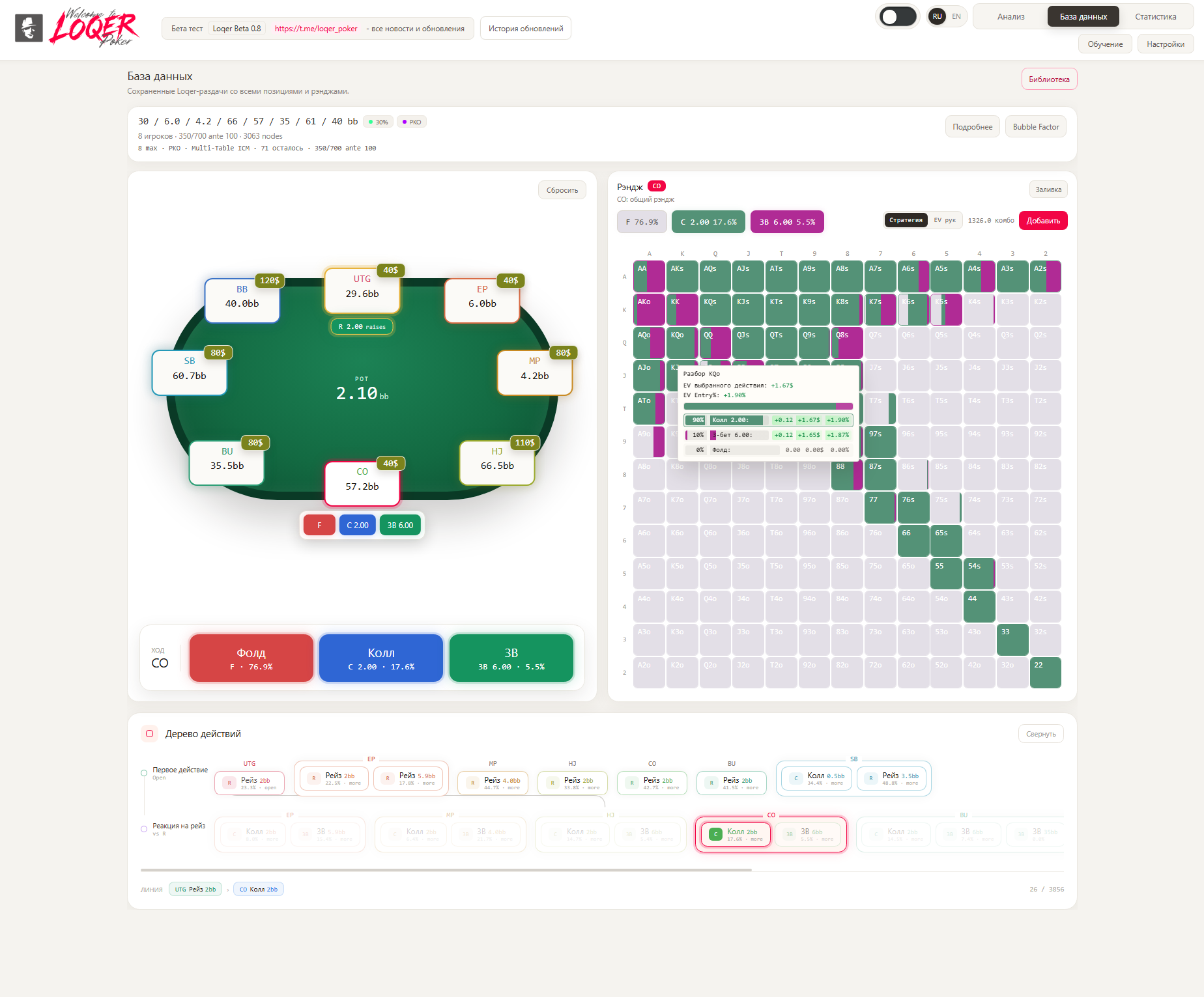
In the LOQER replayer you see the final action together with positions, stacks, the action line, ranges, selected hand EV and how tournament risk changes the decision.
How to study an ICM spot in LOQER
theory -> actionOpen a tournament spot
Choose a bubble, final table or pay-jump hand from the database. Start with positions, stacks, blinds, ante and players remaining, not only the hole cards.
Compare chip EV and tournament risk
Use the range matrix and hand EV view to find hands that look natural by equity but become close because of Bubble Factor and bustout risk.
Find hands whose best action changes
Switch between strategy and hand EV. You can see where a hand still calls, where it folds, and why the same A-high or pocket pair changes against different stacks.
How to review an ICM spot
A useful review does not start with “do I have enough equity?” First, understand the tournament situation.
- How many players are left and which pay jumps are next.
- Who covers whom.
- Whether short stacks force medium stacks to play more carefully.
- What shoving range the opponent has and which hands remain profitable calls under ICM.
- Which hands lose the most EV when you move from chip EV to ICM.
When ICM matters most
ICM does not affect every spot equally. Early in a tournament, chip EV is often the main guide. The closer you get to prizes, final tables and major pay jumps, the more expensive a mistake becomes.
- Tournament bubble.
- Final table and the final-table bubble.
- Satellites with flat prizes.
- PKO tournaments where bounty value and tournament life both matter.
- Medium stack versus big stack, especially with a short stack at the table.
Is ICM only for professionals?
No. Even basic ICM awareness prevents expensive mistakes: loose bubble calls, overvalued medium-strength hands and poor medium-stack decisions.
Does ICM always make you tighter?
Not always. It often makes calls tighter, but shoves against pressured players can become wider. The key question is who risks tournament life.
How is ICM different from chip EV?
Chip EV evaluates a decision in chips. ICM estimates the payout value of stacks using payouts and table stacks. In tournaments, those are not the same thing.