
Short answer: A range is a map of likely hands, not a guess at one exact combo. In LOQER you can set it with frequencies, colors and weights, then see how each edit changes equity and the final decision.
What is a poker range?
A poker range is the set of hands a player could take a particular action with. Instead of asking, “What exact hand do they have?”, ask, “Which hands would they play this way?”
Ranges are usually shown in a 13 by 13 matrix: pairs on the diagonal, suited hands above it and offsuit hands below it. Cell color shows action or frequency, while the percentage shows how many starting hands are included.
Why range thinking matters
Seeing one hand at showdown is not enough to define a range. If an opponent shows A-K once, that does not mean they only take that action with strong hands. A range keeps the full group of possible combos in view.
Working on ranges is especially important preflop, in ICM spots and when comparing lines. A small frequency or weight change can move equity and change the final decision.
- A range describes a set of possible hands, not a guess.
- Frequencies show how often a hand takes an action.
- Weights model mixed strategies.
Range vs equity
A range answers which hands reached the decision. Equity shows how that group performs against another range on a specific board. That is why range and equity should be reviewed together: define the possible hands first, then check how they perform by board and line.
In LOQER, the matrix shows range composition while the equity view shows the advantage. When you change a hand frequency or remove weak combos, both range percentage and final equity can move.
How this looks in LOQER
In LOQER, the range matrix sits next to the board, equity and action tree. You can see the range percentage, exact cells, weights, selected hand and how the range changes through the hand line.
This is useful after a session: open a close spot, assign a range, then check which hands continue, which fold and where the action EV changes.
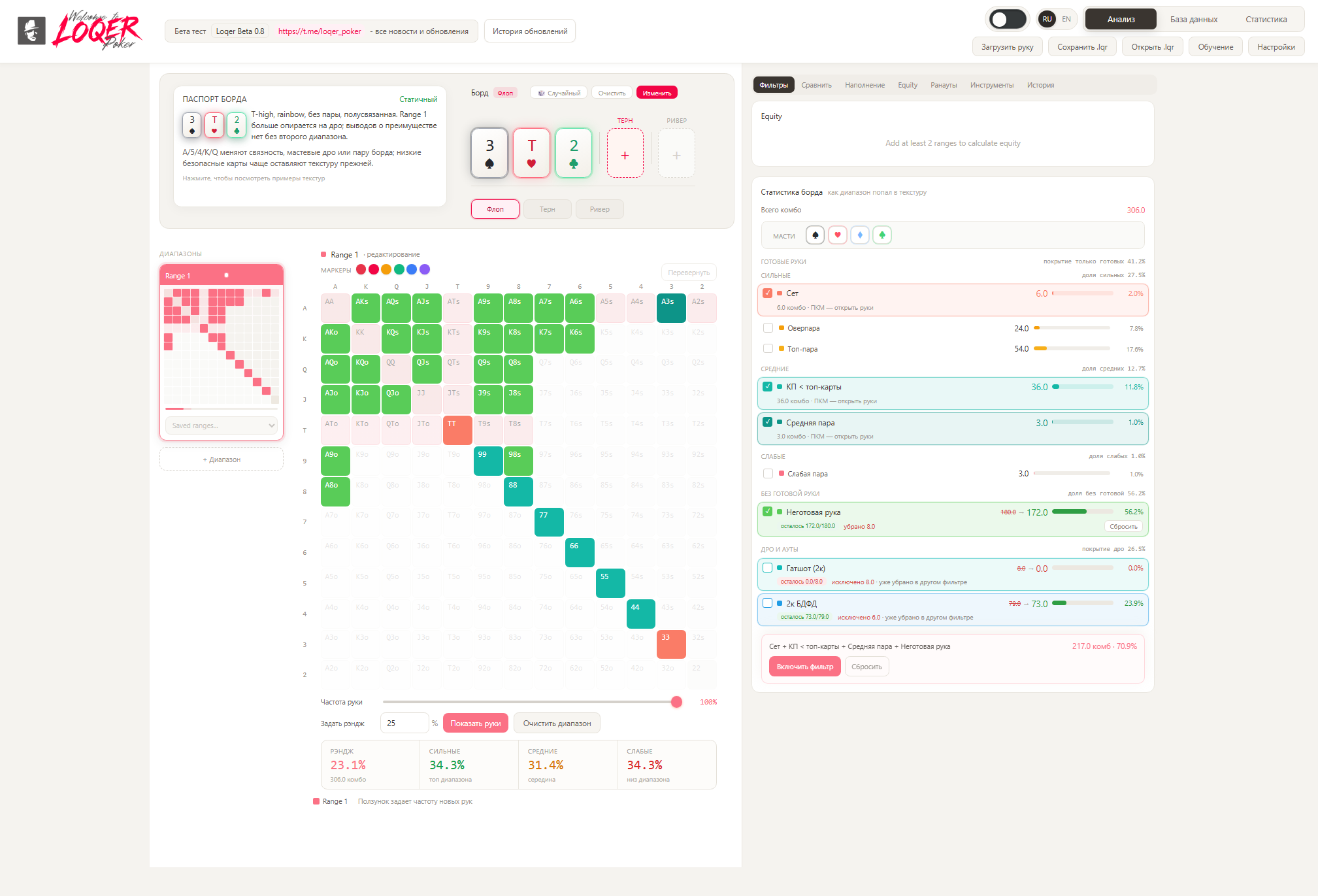
Review the ranges, board and betting action together, so you can judge each decision in context.
A step-by-step review
Start with position and action: who opened, who called, who 3-bet. Build the starting range, then refine it street by street while keeping stack depth, tournament format and ICM in mind.
The common mistake is building the range to justify the answer you want. First describe the possible hands honestly, then inspect equity and action EV.
- Identify position and first action.
- Build the starting range in the matrix.
- Refine frequencies by board and line.
- Compare equity and action EV.
Is a range the same as a chart?
A chart is a saved or recommended range. A range is the underlying set of hands for an action.
Where should a beginner start?
Start with preflop ranges by position: opens, calls and 3-bets. Add postflop filtering later.
Do I need to memorize every chart?
No. Charts help, but the goal is to understand position, stack depth, equity, fold equity, ICM and opponent response.