
Short answer: Review the hand node by node: who acted, what the stack and pot were, which range reached that point and what EV the alternatives had. This finds the mistake in the decision, not in the final result.
Why a replayer matters
After a difficult hand, it is easy to focus on the result: “I got unlucky” or “Why did they call?” A replayer brings you back to the facts: positions, stacks, betting action, board cards and the decision itself.
When the hand line is visible as a tree, it is easier to find the real mistake: starting range, sizing, call, shove or response to a previous action.
What to inspect first
Start at the decision you want to review. Who is acting? What are the effective stacks and pot size? What happened earlier, and which hands could each player still have?
Then compare action EV. Sometimes an action is profitable, but another option has a much higher EV.
- Positions and effective stack.
- Previous action line.
- Range at the current node.
- Selected hand EV and alternatives.
How this works in LOQER
In LOQER, the replayer sits next to the matrix, equity and spot database. You can walk through the action tree, select a specific hand and see why the decision changes.
This turns review from “look at one street” into a full workflow: ranges, board, EV and tournament risk stay in one workspace.
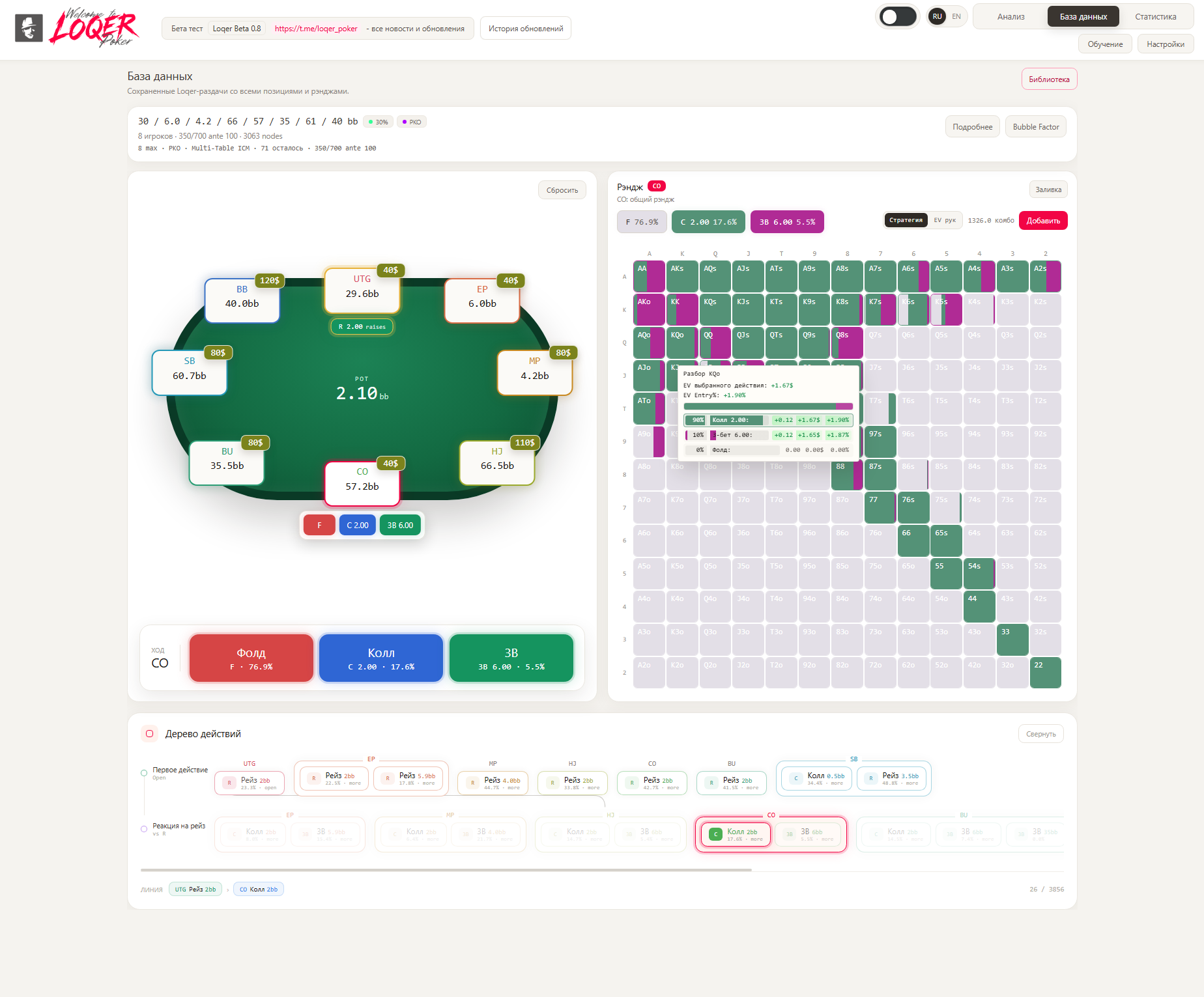
Review the ranges, board and betting action together, so you can judge each decision in context.
Is a replayer only for lost pots?
No. Some of the best discoveries come from won hands where the action was profitable but not optimal.
What matters more: result or action EV?
Action EV matters more. A single result tells you little about decision quality. EV compares the expected outcomes of your options under the chosen assumptions.
Can I review tournaments?
Yes, especially ICM spots, final tables, bubbles and PKO decisions.