Short answer: position decides how much information you have before acting. Late positions usually play wider, early positions play tighter, and blinds follow special rules because part of the pot is already posted.
What is position in poker?
Position is your seat relative to the blinds and the betting order. Preflop it tells you how many players can still enter after you. Postflop it tells you whether you act first or after the opponent.
A player in position sees the opponent’s action before deciding. That gives more control over pot size, bluff frequency, thin value and check-backs. A player out of position often acts with less information.
Early, middle and late position
Early positions play tighter because many players remain behind. If you open a weak hand from UTG, several opponents can still wake up with a strong hand, 3-bet or call in position.
Late positions play wider. CO and BTN have fewer players behind and often gain postflop position. This is why the button usually opens more hands than UTG or MP.
- UTG and MP need stronger starting ranges.
- CO and BTN attack blinds and play wider.
- SB can attack BB but usually plays out of position after a call.
- BB defends wider because the blind is already posted, but many hands realize equity poorly out of position.
How position changes ranges
A range does not exist separately from position. A9o can be a standard button open, a close CO decision and a fold from early position. The same is true for calls and 3-bets: worse position requires stronger hands.
Postflop, position affects equity realization. A hand may have acceptable equity against the opponent’s range, but out of position it is harder to reach showdown, choose sizing and take a free card.
Position, c-bets and pressure
The player in position controls the tempo more often. After an opponent checks, they can continuation-bet, check back or make a thin value bet. The out-of-position player often reveals information first.
But position does not give an automatic right to bet every board. If the board favors the opponent’s range or gives them more nutted hands, even the in-position player must slow down.
How to review position in LOQER
In LOQER, position is not just a label. You can see who opened, who called, who acts first on the flop and how ranges change after each action.
A practical workflow: set positions, mark preflop ranges, add the board and compare equity. If the decision is close, check hand categories, board texture and the selected action EV.
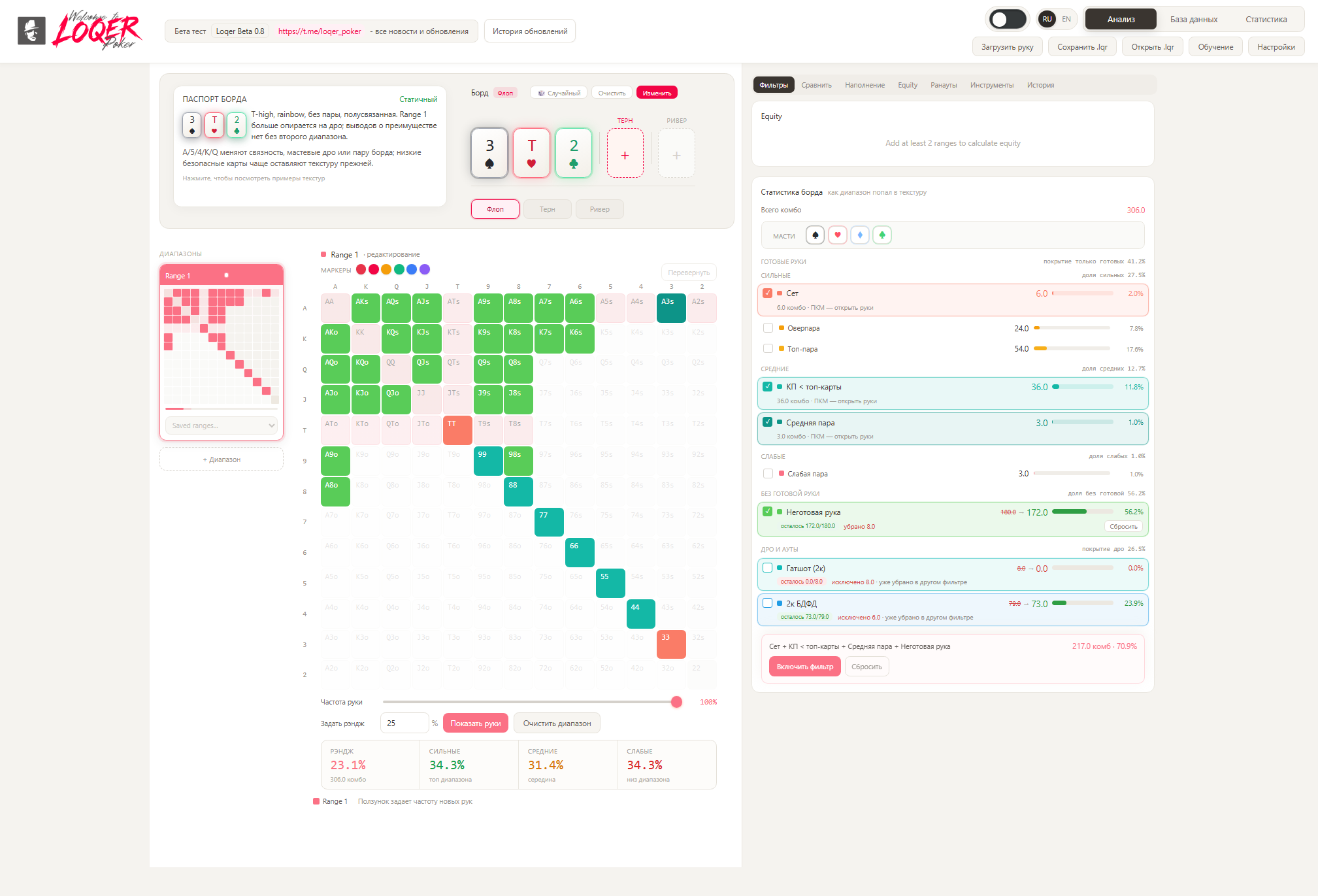
Position becomes clearer when it sits next to ranges, the board, texture stats and the hand action line.
Why is the button the best position?
The button usually acts last after the flop, sees opponent decisions first and can choose bets, checks and bluffs more accurately.
Why are blinds difficult positions?
The blinds have already put chips in the pot, which can improve the price of calling. But they often play out of position after the flop, making equity harder to realize.
Can I play the same range from every position?
No. Earlier positions need stronger ranges; later positions can profitably open more hands.