
Short answer: First check the hand or range equity, then compare it with call price, fold equity and tournament risk. If equity is enough only in isolation, the action can still be poor in EV.
What is equity?
Equity is the expected share of the pot a hand or range receives if the remaining cards are dealt and there is no further betting. If a hand has 40% equity, it wins about 40% of the pot in the long run against the given ranges.
Equity depends on your opponent’s range and the board. The same hand can be strong against a wide range and weak against a narrow value range.
Equity is not EV
High equity does not automatically make a call correct. Consider pot odds, future betting, rake, stack depth and ICM. When comparing aggressive actions, fold equity matters too. In tournaments, a hand can have enough chip equity but still be poor in $EV.
Equity is the starting point of a review, not an instruction to take a particular action. After equity, compare fold, call, raise, shove and their action EV.
- Equity measures your expected share of the pot, including split pots.
- EV asks how much the action earns.
- ICM can raise the required equity threshold.
- Board texture changes equity across streets.
Equity vs ICM
A call can be profitable in chips without being profitable under ICM. In a tournament, losing chips can cost more prize-pool equity than winning the same amount adds. This raises the equity you need to call and can turn a close call into a fold.
If the spot is near the bubble, at a final table, or against a stack that covers you, equity alone is not enough. Also check ICM, Bubble Factor and Risk Premium.
How to review equity in LOQER
LOQER compares ranges next to the board so you can immediately see who has the advantage. This avoids manual combo counting and makes range advantage easier to read.
For training, change the board and watch equity move: dry boards, connected boards, flush draws and overcards behave differently.
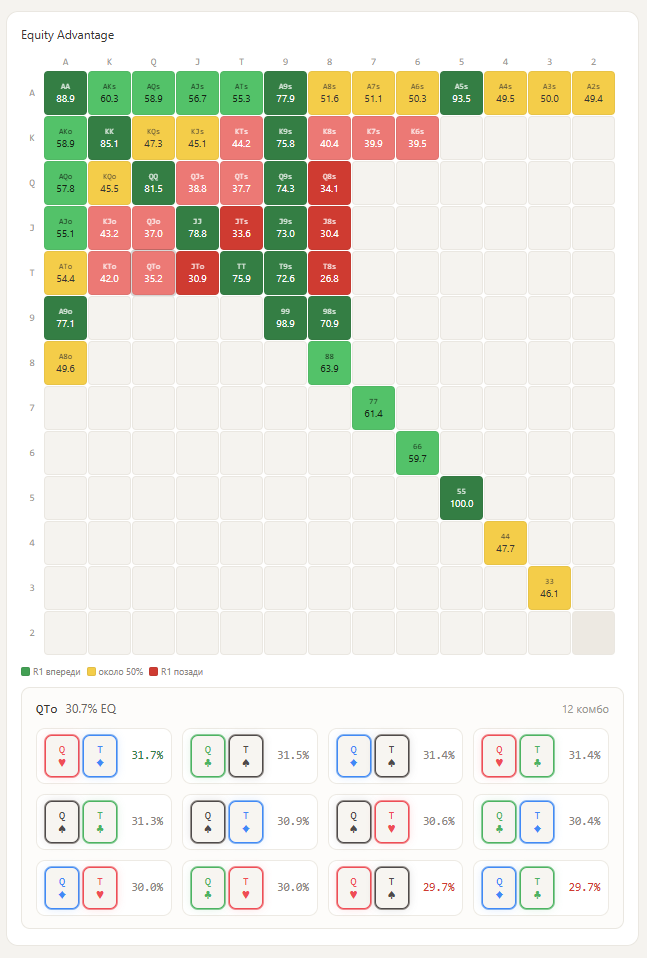
Review the ranges, board and betting action together, so you can judge each decision in context.
Hand equity or range equity?
Use range equity to understand the overall matchup. Use individual hand equity when reviewing a particular holding. Both are useful.
Why does equity change on the turn?
The new card changes available combos, draws, pairs, nut advantage and blockers.
Can I decide only by equity?
No. Consider the cost and expected value of each action. In tournaments, also account for ICM and risk premium.