
In short: range vs range shows how one range performs against another on a specific board. You should look beyond total equity and check strong hands, nuts, draws and medium-strength hands.
What is range vs range?
In real hands we rarely know the opponent's exact holding. So instead of “my hand against his hand”, we compare range against range: which hands each player can reasonably have at this point.
This is especially useful on the flop and turn. One board may strongly favor the preflop raiser, while another may favor the defending player. That changes c-bets, checks, raises, bluffs and value bets.
Equity advantage
Equity advantage shows which range has a higher expected share of the pot at showdown. If one range has 58% and the other 42%, the first range has a mathematical edge, but that does not mean it must always bet big.
You still need to look deeper: sometimes total equity is close, but one range has more nutted hands. In other spots a range has many medium-strength hands that win often but dislike heavy pressure.
Nut advantage
Nut advantage means having more of the strongest possible hands. On some boards, the BB defender may have more two-pair, straights or other strong combinations than an early-position raiser.
When a range has nut advantage, it can often apply pressure with larger bet sizes or check-raises. When nutted hands are rare, even good total equity may require more careful play.
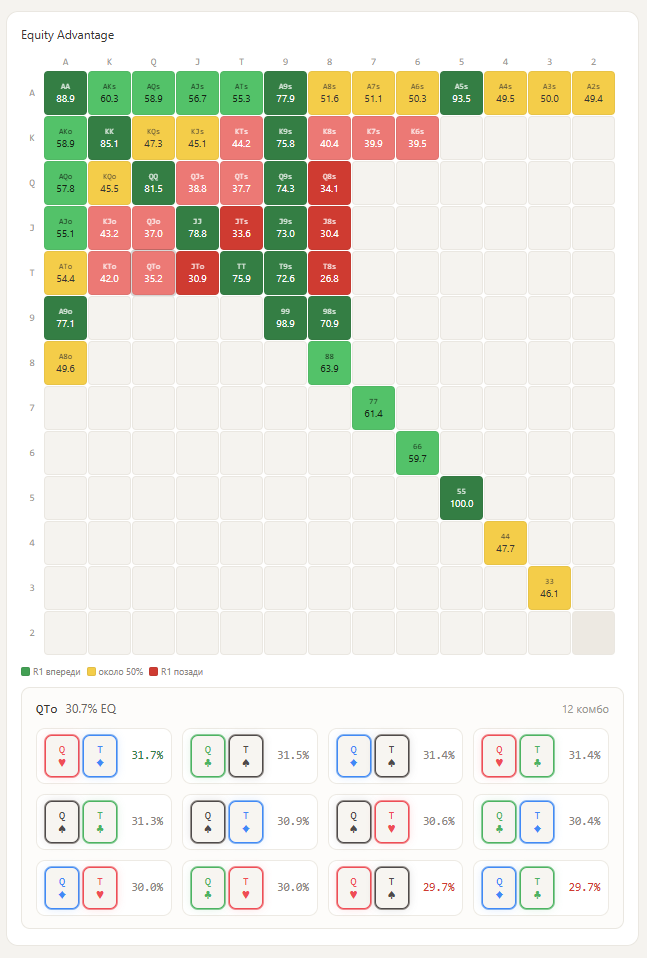
In LOQER, you can edit ranges and the board, then immediately see equity, hand categories and how advantage moves between players.
How to review range vs range
- Define preflop actions and player positions.
- Assign realistic ranges rather than choosing hands to justify the answer you want.
- Add the board and check total equity.
- Review strong hands, draws and medium-strength hands.
- Only then choose sizing and action line.
Common mistakes
- Looking only at your exact hand and ignoring the full range.
- Treating total equity as permission to always bet large.
- Ignoring who has more combinations of the strongest hands.
- Using the same plan on dry and dynamic textures.
Is range vs range only postflop?
It is most useful postflop, but the logic starts preflop: positions and actions define starting ranges.
Are equity advantage and nut advantage the same?
No. Equity advantage is the average share of the pot; nut advantage is about the strongest hands.
Can I decide only by equity?
No. You also need sizing, position, equity realization, fold equity and tournament risk.