
Short answer: start with position and effective stack, then choose a baseline opening or defense range. After that, adjust for opponent, ICM, bounty and sizing instead of playing one chart in every spot.
What is a preflop range?
A preflop range is the group of starting hands a player uses before the flop: open, call, 3-bet, shove or defend. It is not a fixed list that works in every spot. It is a starting point for a particular position and situation.
For example, a BTN opening range is usually wider than a UTG range because fewer players remain behind and there is more chance to win the pot uncontested. BB defense depends not only on hand strength, but also on call price, raise size, antes and postflop realization.
Why position changes the range
The earlier the position, the more players may still have a strong hand. Early positions therefore play tighter: more strong pairs, strong aces and broadways, fewer marginal suited connectors and weak offsuit hands.
Late positions can open wider because they get more folds and often play postflop in position. But a wide open does not mean an automatic call versus every 3-bet: many hands open for fold equity and should fold against strong resistance.
- UTG and MP usually need stronger starting ranges.
- CO and BTN use positional pressure more often.
- SB opens many hands but plays out of position after a call.
- BB defends wider because the mandatory 1bb blind is already posted, but not every hand realizes equity equally.
A chart is not the final decision
A preflop chart gives you a starting point, but it does not solve the whole spot. The same hand can be a standard BTN open, a close call against a 3-bet and a poor defense when sizing is large, stack depth is awkward or ICM pressure is present.
That is why it helps to review more than whether a hand appears in a table. Position, effective stack, antes, bounty, sizing and postflop equity realization all matter. In LOQER, that context stays connected to the range matrix, board, action tree and selected-hand EV.
Open, call and 3-bet are different ranges
The same hand can be a good open raise but a poor call against a raise. When you open, you can win the pot immediately. When you call, you cannot win immediately. You need to realize your equity against the opener’s range after the flop.
A 3-bet range is not just top hands. It includes value hands and sometimes bluffs with blockers or playability. In tournaments, stack depth and ICM can significantly change 3-betting ranges: a medium stack against a covering stack cannot pressure as freely as the big stack.
- Opening range: hands you raise when no one has entered the pot.
- Calling range: hands that can profitably continue against the raise.
- 3-betting range: hands you re-raise, for value or as a bluff.
- Push/fold ranges matter when stacks become short.
How to review preflop in LOQER
In LOQER you can set a range in the matrix, mark frequencies, choose a specific hand and see how it behaves through the line. This is useful when you review a real hand from the database, not an abstract chart.
The workflow is simple: choose the position, set the baseline range, add sizing and stack depth, then check which hands continue against the opponent action. If the decision is close, move to equity, Bubble Factor and selected-hand EV.
- Set position and first action.
- Mark the baseline range in the matrix.
- Check how sizing changes defense and 3-bets.
- Compare close hands through equity and EV.
How to study preflop ranges
Do not try to memorize every chart at once. Pick one format first: for example 40bb without ICM or a final table with ICM, then review similar spots in batches. You will quickly see which hands are borderline decisions.
After each session, mark close preflop decisions: an overly wide open, a loose call, a missed 3-bet or an overly tight big blind fold. After a few reviews, patterns in your mistakes become easier to spot.
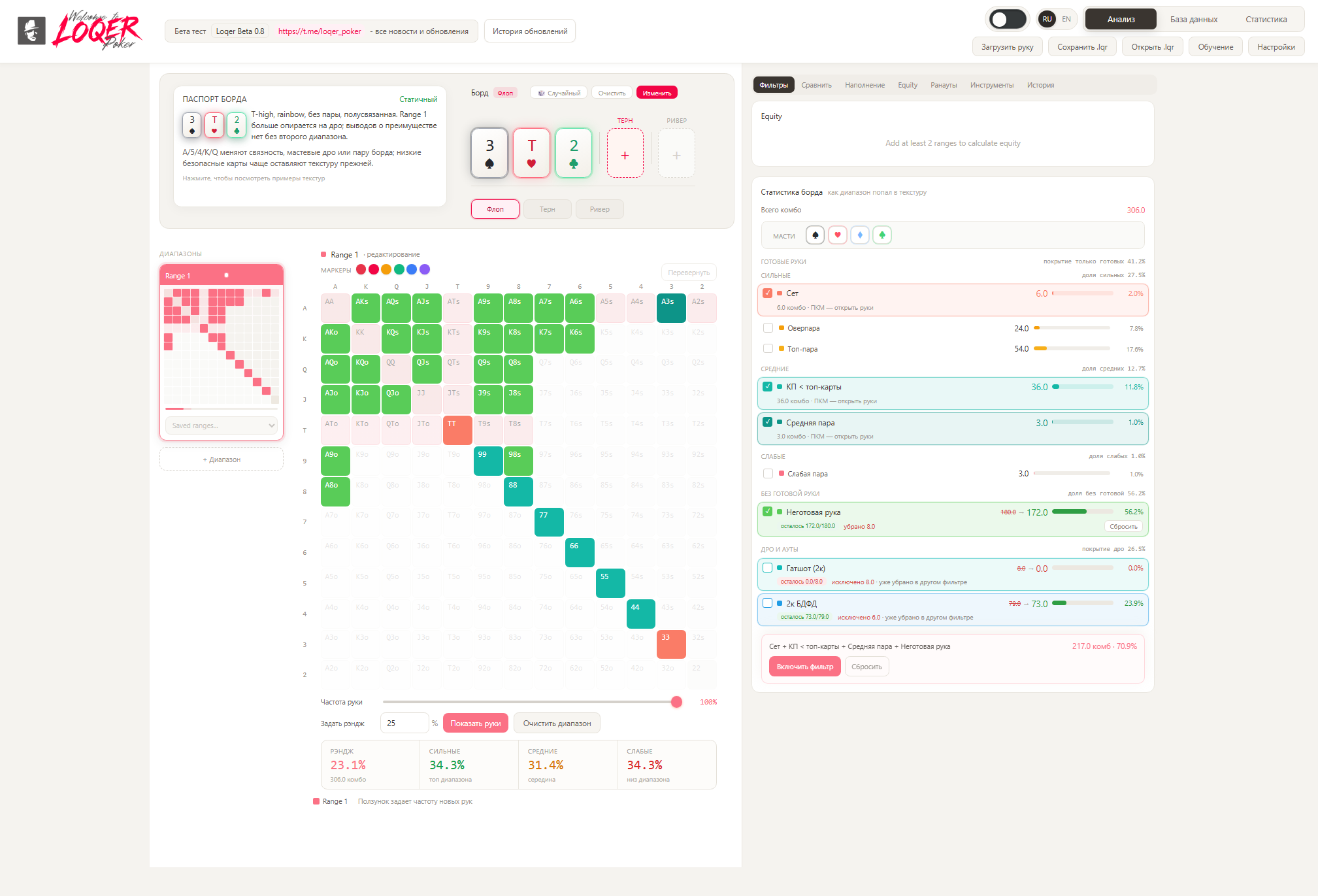
In LOQER, the preflop matrix sits next to board filters and hand review, so a range stays connected to the real hand.
Should I play only from charts?
No. Charts are a starting point, but real ranges depend on opponents, stacks, sizing, antes, ICM and bounty.
Why does BTN open wider than UTG?
On the button fewer players remain behind and you have position after the flop, so more hands become profitable.
When should a preflop range tighten?
When you are covered, a short stack is nearby, opponents 3-bet often, or your hand realizes equity poorly after calling.